
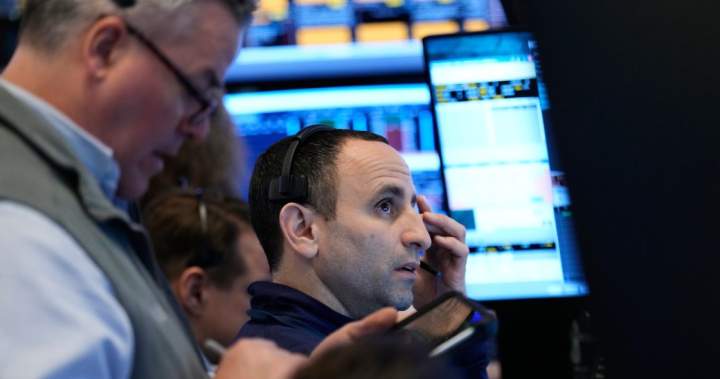

U.S. stocks are falling sharply Friday after getting a whiff of a worst-case scenario for financial markets: a weakening economy combined with high inflation.

The S&P 500 dropped 1.6 per cent after a report showed U.S. employers cut more jobs last month than they created and after oil prices jumped to their highest level in nearly two years because of the Iran war. It’s a combination that investors hate because no one in the world has a good tool to fix both a weak economy and high inflation at the same time.
The Dow Jones Industrial Average was down 823 points, or 1.7 per cent, as of 10:10 a.m. Eastern time, and the Nasdaq composite was 1.4 per cent lower.
The Toronto Stock Exchange fell almost 600 points, or 1.75 per cent as of publication.
“You can’t sugarcoat this report,” according to Brian Jacobsen, chief economic strategist at Annex Wealth Management.
“A negative payrolls number combined with a big jump in oil prices will have traders worrying about stagflation risks.”

Stagflation is what economists call a stagnating economy combined with high inflation, and a separate report released Friday added to the sour mix after showing that U.S. retailers made less money last month than economists expected. It raised the disconcerting possibility that spending by U.S. households, the main engine of the economy, may be stretched near its maximum.

Get weekly money news
Get expert insights, Q&A on markets, housing, inflation, and personal finance information delivered to you every Saturday.
Usually when the economy is unsteady and the job market is weakening, the Federal Reserve cuts interest rates to give things a boost. Lower rates can make it more affordable for households to get mortgages and companies to raise money to build factories, while also helping prices for stocks and other investments. The Fed cut its main interest rate several times last year and had indicated more were to come this year.
But lower interest rates can also make inflation worse. And the Fed’s hands may be increasingly tied because spiking oil prices are pushing inflation higher due to disruptions for the energy industry because of the war.
The price for a barrel of Brent crude, the international standard, jumped another 6.9 per cent to US$91.35 and touched its highest level since April 2024. A barrel of benchmark U.S. crude climbed 9.2 per cent to $88.45.
Oil prices have surged, with Brent up from near $70 late last week, as the war has expanded and included areas critical to the production and movement of energy in the Middle East. Much will depend on what happens with the Strait of Hormuz. Roughly a fifth of the world’s oil typically sails through the narrow waterway off Iran’s coast.
If oil prices spike further, like to $100 per barrel, and stay there, some analysts and investors say it could be too much for the global economy to withstand.
To be sure, the U.S. stock market has a history of bouncing back relatively quickly following conflicts in the Middle East and elsewhere, as long as oil prices don’t jump too high for too long. Uncertainty about what will happen has caused frenetic swings across financial markets this week, sometimes hour by hour.
On Thursday, for example, the Dow dropped more than 1,100 points before paring it to a loss of 784. On Monday, the S&P 500 erased a loss of 1.2 per cent entirely to end with a tiny gain.


U.S. President Donald Trump’s most recent signal on the war was that he wants an “unconditional surrender” of Iran, apparently ruling out negotiations.
In the bond market, Treasury yields rose further as the jump in oil prices pushed inflation pressures upward. More traders are betting on the possibility that the Fed will cut interest rates just once this year, instead of at least twice, according to data from CME Group.
The yield on the 10-year Treasury climbed to 4.17 per cent from 4.13 per cent late Thursday and from just 3.97 per cent before the war with Iran started.
Smaller companies often feel the bite of high borrowing costs more because many need to borrow to grow. Smaller companies can also be more dependent on the strength of the U.S. economy than big multinational rivals, and the smallest stocks on Wall Street took the sharpest dives Friday.
The Russell 2000 index of small stocks fell a market-leading 2.2 per cent.
It was a near wipeout among the biggest stocks on Wall Street as well. More than 90 per cent of the stocks within the S&P 500 index dropped.
Companies with high fuel bills led the way. Old Dominion Freight Line sank seven per cent, Norwegian Cruise Line Holdings fell 6.1 per cent and Southwest Airlines lost 5.7 per cent.
In stock markets abroad, indexes slumped in Europe following a better finish in Asia. France’s CAC 40 fell 1.3 per cent, and Germany’s DAX lost 1.5 per cent, while Hong Kong’s Hang Seng jumped 1.7 per cent and Japan’s Nikkei 225 added 0.6 per cent.
– With a file from Global’s Ariel Rabinovitch
© 2026 The Canadian Press
#Stock #markets #plummet #oil #nears #Iran #war #U.S #job #losses #National