
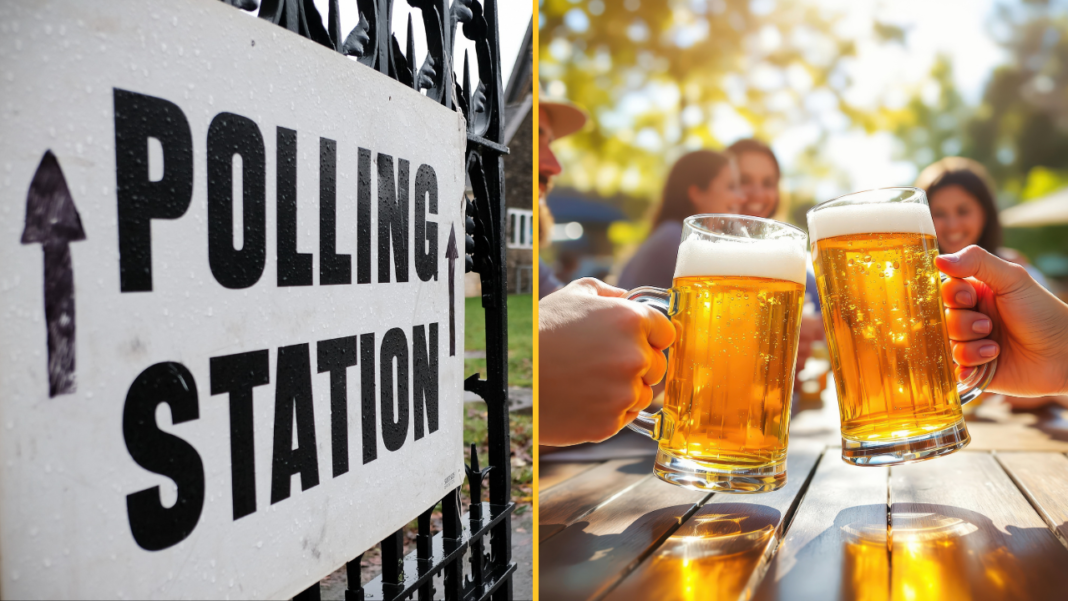

‘Now, imagine your pint is council tax’
Look, the pub is a place for talking about anything – work, relationships, sport, the list is endless.
While many shirk around the volatile pit of political conversation, it can be good to discuss it with people of all opinions, especially for an open mind.
Despite all this, many may be sat in the pub thinking – what actually are the local elections?
Good question, we’re here to explain like your favourite local pub custodian and also provide a guiding hand if you have decided to vote tactically.
The local elections explained like a pint of beer
Local elections are a super important part of manifesting democracy in the UK, having the potential to affect politics on the smallest and largest scales.
Local elections don’t just decide whether your ward and council are red, blue, green, yellow or any other politically symbolic colour, but also have a direct impact on your community.
Imagine that your pub is the UK and your pint glass is your local council.
To fill the glass you need beer – imagine the beer filling the pint glass is council tax.
Now, a full glass represents the budget of the council, and each sip is money allocated to a different service in your area.
I’ll be honest, while it started well, that was a pretty poor analogy, so here it is in simpler terms.
Councillors and their councils are responsible for a much larger number of services than people think, and actually are much more heavily involved than MPs often are in their communities.
Depending on the type of authority, your council is responsible for everything from education, social services, waste disposal, planning, public security and trading standards and of course POTHOLES – you know, the stuff that directly affects your everyday life.
Waste disposal is one of a number of services carried out by the council. Credit: Adobe Stock.
This is ultimately why you pay money – council tax – to your local authority, because these are the people managing the services where you live.
More than just local
While, of course, local elections have a direct impact on where you live, there is also a bigger picture.
Many use the local elections as a chance to protest against the current government, with some parties even running on this idea as a manifesto.
A change in hands between parties at council level can be a huge boost for a party trying to prove that they are the next best option to lead the country, come the following general election.
With this in mind, both Reform and Green will be looking to make the most of the anti-Labour sentiment sweeping the nation.
Often people will say “a vote for us is a vote against them”, and that is indeed true in tightly fought areas.
What do the polls say?
There are around 5,000 seats up for election and about 60 councils projected to change hands, as per Poll Check.
The polling organisation say that when most of the seats up for election this year were last contested, Labour polled at 35%.
This has since dropped to 20%.
The biggest improvers are, of course, Reform UK and the Greens who have skyrocketed in popularity since the general election.
The big winners
If the polls are to be trusted, Reform UK will be the big winners of the 2026 local elections.
Out of the around 5,000 seats up for grabs in this round, Poll Check predicts the most will be won by Reform with 1,470 seats.
Meanwhile, Labour are predicted to finish second with 1,139 – a huge decrease of 1,164 down from their previous 2,303 seats.
The Tories are set to lose 563 seats, dropping to just 667.
The other big winners will be the Lib Dems and the Greens.
The Lib Dems are set for a 121-seat increase up to 828, while the Greens are predicted to shoot up by 456 seats to 640.
How the local elections could play out. Credit: Poll Check / Adobe Stock.
Of course, where it really matters are in the numbers of councils parties will form majorities and take control.
With Labour’s collapse, a large number look set to become No Overall Control (NOC) while Reform could win as many as 10 councils.
As per Poll Check, Reform are predicted to control of nine councils, while 35 are set to turn NOC.
A large number of others are considered ‘battleground’ councils where it’s potentially too tight to call.
How to vote tactically – if you wish
If you have made your mind up that you are going to vote tactically then there are indeed sites that help with that eventuality.
For example, if you wish to stop Reform getting control of a council in your area, then, incredibly like most things in life, there is a website for that.
Stopreformuk.vote has set up a website where if you put in your postcode where you will be voting, it will recommend which way to vote to prevent Reform from winning.
While the only sites that give advice on tactical voting are anti-Reform, if you have a different viewpoint and wish to vote tactically against Labour, the Tories, or anyone else for that matter, you can use Poll Check to find the predicted outcome for you ward.
You will be able to see each party’s vote share and then, depending on who you want to win, or not win, make your own choice from there.
The all-important caveat
Because local elections are often done in thirds for many councils across England, this means that elections are held often year-after-year, filling part of the entire council each time.
This means that, while Reform could win the most seats up for grabs this year, the party in control of a council may not necessarily change.
In fact, in this scenario where Labour look to lose a huge number of seats, this bit-part system could lead to a large number of NOCs as the party lose seats, but keep a large number of others from other, past local elections.
Still, this is no excuse to get out there and exercise your suffrage – not everyone is so fortunate.
You can search the predicted results for your council using Poll Check’s website here.
#weeks #local #elections #explained #youre #pub