
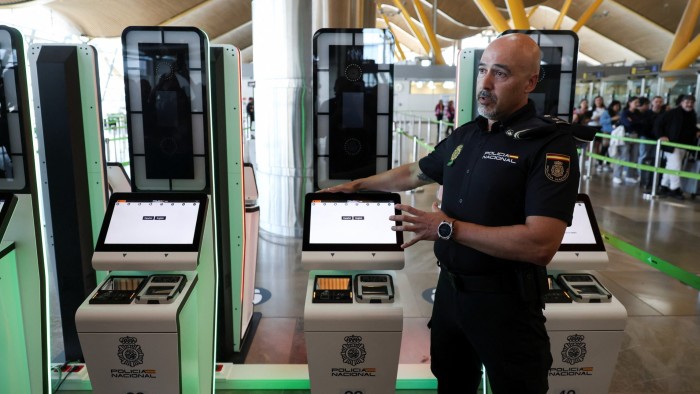

Europe’s airports and border crossings are braced for potential congestion when a long-delayed security system that tracks passengers’ fingerprints is rolled out on Sunday.
Operators will begin registering biometric photos and fingerprints from people leaving or arriving in the bloc at certain border crossings, as the new Entry-Exit System (EES) is gradually introduced over six months.
Ports, airports and train terminals have had to install machines to carry out the checks, which will enable officials to cross-check information about people’s immigration status and automatically identify those who overstay their visas or permitted stays.
“We will know who enters the EU when and where. It is the digital backbone of our new approach to border management,” EU home affairs commissioner Magnus Brunner told the Financial Times.
The system had been repeatedly delayed by concerns that the computer systems were not ready and that travel would be disrupted. EU countries ultimately decided to roll it out step by step, meaning it will only be fully operational on April 10 2026, when it will replace manual passport stamps.
“Rolling out this large-scale IT system across 27 member states is a complex and demanding task — yet one for which we are prepared,” Brunner said. “The six-month implementation period will ensure that member states, travellers and businesses can adjust smoothly.”
Despite the ramp up, ministers in the UK are bracing for long delays next summer, especially during school holidays.
The Department for Transport has secured two large sites in Kent that will serve as additional queues for vehicles waiting for the Eurotunnel or port of Dover, to try and prevent cluttering the road network.
Alex Norris, minister for border security and asylum, said the checks will be “a significant change for British travellers, which is why we have worked closely with our European partners to ensure the rollout goes as smoothly as possible”.
The UK government has provided £10.5mn to ports and operators with the transition, predominantly in setting up testing sites.
Simon Lejeune, a senior director at Eurostar, said the “staggered introduction of EES . . . is very welcome”. He added: “This will help support a smoother operation and enable customers to get used to the EES process.”
While the system is similar to e-gates in operation at many airports, operators are nonetheless braced for complaints from customers who suffer delays, as registering the biometric information for the first time will take longer than subsequent checks.
“Much will depend on how the system will behave on launch day, and on adequate police staffing at the control posts,” said Ourania Georgoutsakou, head of lobby group Airlines for Europe.
“Most importantly, airline crews should not be held up at the border, and they will be processed as quickly as possible, in the same way as before.”
ACI, which represents European airports, stressed that “the management of border crossing points lies with the [EU] member states, not with airport operators”.
The system will be introduced by the 29 countries of the borderless Schengen area, also including Switzerland, Iceland, Norway and Liechtenstein. The checks will not apply to people holding EU residence permits or long-term visas.
Countries will at first start implementing the checks only at certain border crossings or for certain categories of people. The Netherlands, for instance, will start at the ports of IJmuiden and Eemshaven, and will only introduce controls at Amsterdam’s Schiphol airport on November 3.
In Germany, biometric controls will start at Düsseldorf airport on Sunday, then at the airports in Frankfurt and Munich, followed by seaports and other crossings.
The system was agreed in 2017 but has been pushed back several times — delays that operators say have allowed them to iron out bugs and carry out testing. “No one has an excuse not to be ready,” Eurotunnel chief executive Yann Leriche told the FT during a demonstration of its technology at Folkestone.
However, while current passport checks are carried out in a vehicle, the new scheme requires people to park in dedicated bays and get out of their vehicles to complete the check, which Eurotunnel estimates takes two minutes per passenger.
The group, which operates car and lorry trains through the tunnel, has spent £80mn setting up self-service checkpoints and hiring staff. It will initially check freight drivers and will roll out the checks to passengers around Christmas.
Eurostar’s kiosks, which are located in its stations before passengers check in, will also ask each passenger four questions, including whether they have a return ticket and funds to support themselves during their visit. Customers who answer “no” will have to speak directly to a border officer. The system will start with business-class passengers.
“Eurostar has invested more than €10mn in its EES preparations, which includes 49 customer kiosks for EES registration and doubling the border capacity at St Pancras with new e-gates and more border positions,” added Lejeune. “This means our check-in times will remain the same with EES.”
People using the Channel Tunnel or ferry crossings will face the checks at border checkpoints in England, while those arriving from the UK to the EU by air will be processed at local airports.
#Airports #brace #delays #starts #fingerprint #checks