

Unlock the White House Watch newsletter for free
Your guide to what Trump’s second term means for Washington, business and the world
The writer is an FT contributing editor, chair of the Centre for Liberal Strategies, and fellow at IWM Vienna
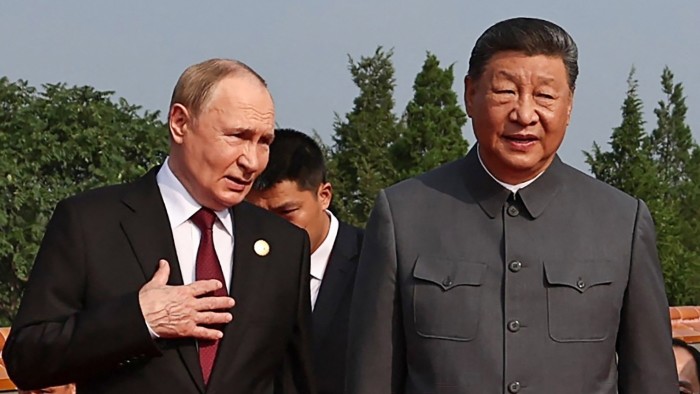
On the sidelines of the military parade in Beijing at the beginning of September, Russian President Vladimir Putin and his Chinese counterpart Xi Jinping were overheard discussing the question of immortality. Not the wars in Ukraine and Gaza, nor their potential successors, and not Trump’s tariffs, but organ transplants and new discoveries in biotechnologies which hold out the quixotic hope of eternal youth.
Could it be that this strange conversation may turn out to be more consequential for the future of our politics than the geopolitical power shift everybody talks about? The conventional wisdom is that “the world is run by old men in a hurry”. What if the great powers are in fact stewarded by old men who are not in a hurry, who believe that they have time — a lot of time? How will their fascination with longevity influence their political choices?
When Putin ends his current term in office — which is highly unlikely to mark the end of his rule — he will have been in power longer than Joseph Stalin or Leonid Brezhnev. He will also be older than both of them.
We often assume that Putin is obsessed by who his successor should be and how a post-Putin Russia will survive. But knowing that some of us — most likely including Putin — will soon be able to live much longer, should a different question be on everyone’s minds? Can the Russian president govern the country for another quarter of a century? How will this elongated timeframe affect his policy choices? Will he be more patient or more aggressive?
Historian Christopher Clark has observed that “as gravity bends light, so power bends time”. The exercise of power is rooted in a certain set of assumptions about how the past, present, and future are interconnected. Modern politics has hewn to a belief that individuals are mortal whereas nations are immortal. We transcend our mortality through our belief in God, bearing children and being part of a self-conscious cultural community that will withstand the storms of history.
Our idea of immortality used to be captured by a monument in a park inscribed with the names of those sacrificing their life for the nation or a poem that future generations would know by heart. As Putin and Xi’s conversation in Beijing suggests, this is no longer the case. We now live in an era when the richest and the most powerful imagine themselves immortal, while many nations, under the pressure of lower birth rates and massive migration, are starting to appear mortal.
Can we still believe that we will live on in the minds of future generations when the speed of ecological, technological and cultural change shatters our capacity to imagine how futures humans will live? Can Bulgarian or Slovak political leaders, for example, be sure that anybody will study Bulgarian or Slovak history 100 years from now?
History reminds us that the pursuit of eternal youth is one of the characteristics of revolutionary times. The life and tragic death of Alexander Bogdanov, a one-time friend of Vladimir Lenin and the founder of Russia’s National Institute of Hematology, who died from the effects of a botched blood transfusion, is the best example of the revolutionary’s pursuit of immortality understood not as the quest for eternal fame but as a search for eternal youth.
Donald Trump may be the most powerful example of the dramatic shifting of the time-power axis. Putin and Xi are still preoccupied with the immortality of nations. The Russian president romanticises a lost imperial past and daydreams about Russia’s eventual demographic revival; Xi invokes dynastic continuity. But Trump is different. He rarely discusses history or how he wants to be remembered by the next generation — unlike Putin and Xi.
He certainly wants to live forever, but not in the hearts and minds of the future generations. Rather, one gets the sense he would happily spend his immortality at Mar-a-Lago, or, even better, in the White House. His political imagination seems not to extend beyond his own tenure — as if history itself should end with him. He betrays little concern for what will happen immediately after him. When discussing the risk of conflict with Taiwan, he repeats Xi’s pledge not to invade the island while Trump is in power. But what about when he is no longer in power?
That conversation in Beijing about immortality signals a dramatic shift in the way political leaders experience the time-power axis. At the end of his second term Trump will be America’s oldest sitting president. But is he really that old? The last US census suggests that the majority of Americans born in 1946, the year of Trump’s birth, are still alive (and many of them continue to vote, presumably). And according to opinion polls, a majority of Republicans think that Trump should run for a third term. Maybe it was his predecessor Joe Biden who was the last truly old American president?
It is difficult to escape the feeling that the future of our politics is beginning to resemble the world of Greek mythology in which the intrigues of the immortals drive world history. For mere mortals, meanwhile, being looked upon favourably by the Immortals is the most they can hope for.
#Putin #live