
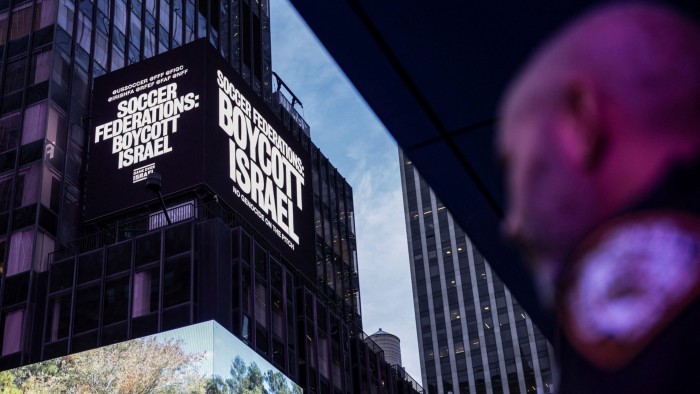

Hours after a UN commission this week accused Israel of genocide in Gaza, a giant billboard appeared in New York’s Times Square repeating the allegation to everyone passing through the city’s busiest pedestrian intersection.
Advocacy groups were seeking to pressure European football federations to boycott Israeli teams after launching a “GameOverIsrael” campaign, a year before New York hosts the World Cup final.
A day later, dozens of musicians including James Blake, PinkPantheress and Saint Levant performed to a packed London arena at a star-studded “Together for Palestine” concert with Palestinian activists and Hollywood actors.
Richard Gere called out US President Donald Trump for not doing more to pressure Israeli Prime Minister Benjamin Netanyahu to end the war in Gaza. Retired French football star-turned-actor Eric Cantona drew cheers as he urged clubs and players to boycott Israeli teams.
“We remember apartheid in South Africa,” Cantona said. “The sporting boycott was critical in ending apartheid . . . We are power, you are power and football teams around the world are power.”
Across sport, the arts and politics, a protest movement against Netanyahu’s far-right government and in support of Palestinians is gaining momentum, born of global outrage over Israel’s nearly two-year war against Hamas in Gaza.
Campaigners against Israel’s occupation of Palestinian territories hope a watershed moment is approaching, with echoes of the struggle against apartheid in South Africa.
By targeting football, activists are seeking to replicate the campaigns that led to Russian teams being expelled from international competitions after Moscow’s full-scale invasion of Ukraine in 2022 — as well as sports boycotts of South Africa decades earlier.
“The cultural pillar of boycotts is so important, and nothing is bigger than sports . . . There’s nothing more global than football,” said Ashish Prashar, an organiser of the “GameOverIsrael” campaign and former adviser to Tony Blair when he was Middle East envoy.

“While white South Africa wasn’t that interested in football, football was still the biggest sport, and when they were thrown out of football every other sport followed,” he said. “If you move forward to Russia, what happened was football went; the Olympics went; then every other cultural institution went.”
Even before the GameOverIsrael campaign launched this week, there were signs that outrage over Israel’s war in Gaza — triggered by Hamas’s October 7, 2023 attack — was filtering into sport.
Last month, the Italian football coaches’ association called for Israel’s suspension from international competitions, citing “daily massacres” in Gaza. Norway’s football association promised to donate ticket revenue from its qualifiers against Israel to humanitarian aid for the besieged strip.
Spanish prime minister Pedro Sanchez this week demanded Israel be banned from all international sports as long as its “barbarism” in Gaza continues. He spoke after protests directed at the privately owned Israel Premier-Tech team forced the cancellation of the final stage of Spain’s La Vuelta a España cycling race.

Days earlier, Israeli players withdrew from a Spanish chess tournament after being told they could not compete under their national flag.
In Hollywood, more than 4,500 actors, filmmakers and others have signed a “pledge to end complicity” inspired by filmmakers’ action against apartheid South Africa. Signatories “pledge not to screen films, appear at or otherwise work with Israeli film institutions . . . that are implicated in genocide and apartheid against the Palestinian people”.
Last weekend, Hannah Einbinder ended her Emmy awards acceptance speech by shouting “Free Palestine!” Javier Bardem strode the red carpet in a keffiyeh, the Arab headdress symbolising support for Palestinians.
In Europe, Ireland, Spain, the Netherlands and Slovenia have threatened to pull out of the Eurovision Song Contest if Israel takes part.
Such actions — alongside large street protests in European capitals — have imbued activist groups like Boycott, Divestment, Sanctions (BDS) with a newfound sense of relevance.
Omar Barghouti, who has spent two decades campaigning for boycotts to pressure Israel after co-founding BDS, believes a “tipping point” has been reached.
“Calling for a boycott of Israel — whether it’s Mark Ruffalo in Hollywood, the president of Colombia or the prime minister of Spain — it’s become normalised,” he said. “It’s our South Africa moment.”
He said one lesson of the anti-apartheid movement was that “states are the last to change”. Activists like BDS focus on shifting corporations, arts, culture, sports and academia to alter public perceptions, hoping that will in turn shift pressure on to politicians.

Attitudes in western capitals are hardening. The UK this month banned Israelis from the prestigious Royal College of Defence Studies for the next academic year.
In the coming days, the UK, France, Canada and Australia are expected to join other nations in recognising a Palestinian state — an expression of support for a two-state solution, but also a strong rebuke of Netanyahu’s government.
Yet for all the comparisons with the anti-apartheid movement — which lasted decades before South Africa transitioned to democracy — there are distinct differences.
The campaign against white rule in South Africa targeted an institutionalised system and was closely affiliated with the African National Congress, then a banned opposition movement. It was organised, structured and in its later years boasted a global figurehead in Nelson Mandela.
In contrast, the protests against Israel’s war and in support of the Palestinians have no lead organisation and are often ad hoc.
Adam Habib, a South African academic and vice-chancellor of Soas university in London, said the street protests were on a similar scale to the anti-apartheid movement, with the “same level of ferment”.
But Israel — which vehemently denies the genocide allegations — is a far more powerful actor than the apartheid regime, with more tools to push back. “The fightback, at least for the hearts and minds, is more substantive in this context,” Habib said.
And apartheid South Africa did not have the backing of a superpower in the way that Israel enjoys the US’s unflinching support.
Former US president Ronald Reagan and his allies “were open to the idea of an apartheid South Africa being a bulwark against communism, but they were not prepared to underwrite that country at any cost”, Habib said. “The relationship between the US and Israel is of a fundamentally different ilk.”

Netanyahu has stuck to his tried-and-tested playbook: berate Israel’s critics as being sucked in by Hamas propaganda and influenced by “Muslim minorities”, while championing himself as the great defender of his nation.
This week he conceded that Israel’s growing isolation would come at a cost.
“I want to make clear that we’re in a different world, a very challenging world,” he told an economic conference. “We will have to increasingly get used to an economy that has more and more indications of autarky.”
Netanyahu was referring to the growing number of states, including the UK, Canada and Germany, suspending arms sales to Israel. He vowed that Israel would expand its own defence industry.
But his comments rattled the stock market and alarmed Israelis who worry their nation is sliding towards pariah status.
Dahlia Scheindlin, an Israeli analyst and pollster, said the impact of the protests and boycotts was so far “fairly limited for the average Israeli”. Yet they have fed anxiety among Israelis, as well as fears about antisemitism.
“Everybody seems to have a story about a family member in another country who had an unpleasant experience,” said Scheindlin, adding that academics in particular were experiencing “a quiet boycott”.
“People who are trying to publish books in English are saying they’re being told by agents it’s a hard time to get a book published if you’re Israeli,” Scheindlin said. “Different academic forums or professional guilds don’t want to have representatives of Israeli organisations, even if they aren’t affiliated with the government. That’s increasingly common.”
Several European universities, including in Ireland, Spain, Italy and the Netherlands, have suspended collaboration with Israeli institutions.
But some Israeli analysts suggest the international condemnation plays into Netanyahu’s hands, allowing him to tap into the perception that the “world is against Jews” and has bought into Hamas’s narrative.
“I’m not sure if it’s the South African moment, but for people like me who want to feel part of the world, it’s a shitty time,” said Gideon Rahat, a political-science professor at Jerusalem’s Hebrew University.
“But [for] the people who are more religious or more nationalist, this [is] the great moment of their lives: ‘We told you the world is against us’.”
Even Israelis who oppose Netanyahu view the criticism as antisemitism, he said, “because there is some antisemitism there, and because people are very sensitive to it”.
Netanyahu shows no signs of caving. In response to the UK and France’s moves to recognise a Palestinian state, his far-right allies laid out plans to annex the occupied West Bank. The day the UN commission accused Israel of genocide, Israeli forces launched a new ground offensive into Gaza City.
“We’re going to be Athens and Super-Sparta,” he told the economic conference. “We have no choice.”
Additional reporting by Josh Noble in London and Neri Zilber in Tel Aviv
#growing #global #boycott #Israel